
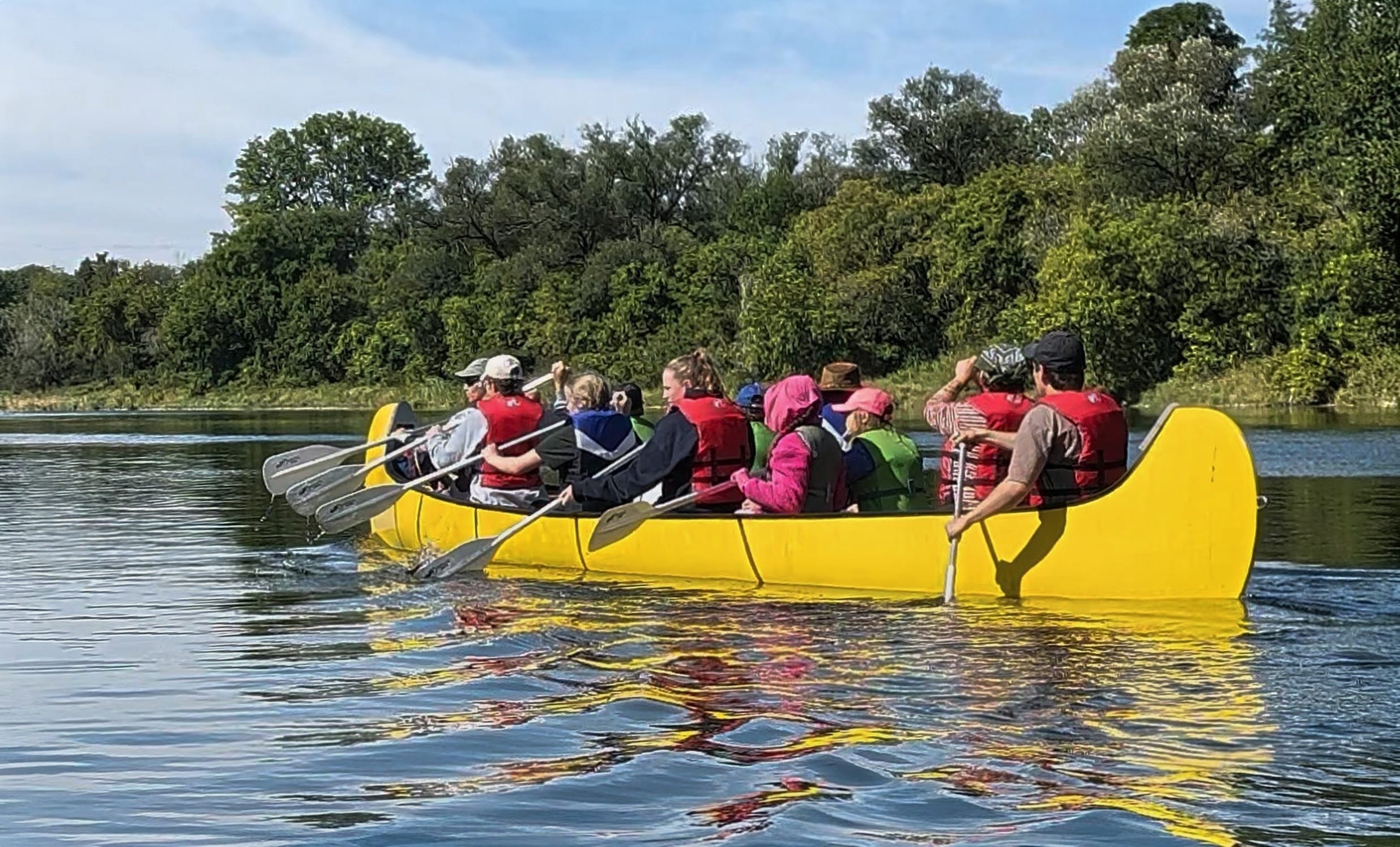
Big Boats, Living History: Taking 25-Foot North Canoes Down the Grand
There is an unmistakable shift in the river when twenty-five feet of canoe slides into the current. In a standard tandem boat, every ripple is a quiet conversation between two people. When you settle ten students into a 25-foot North canoe, however, you aren’t just launching a boat—you are steering a floating community.
This September, we trailered our two 25-foot Voyageur canoes down to Brant Conservation Area for a school group outing. That broad, island-braided stretch of the Grand just outside Paris is practically made for big hulls. The river splits around low gravel bars, tall grass lines the channels, and the moment the bows point downstream, the distractions of the classroom simply evaporate.
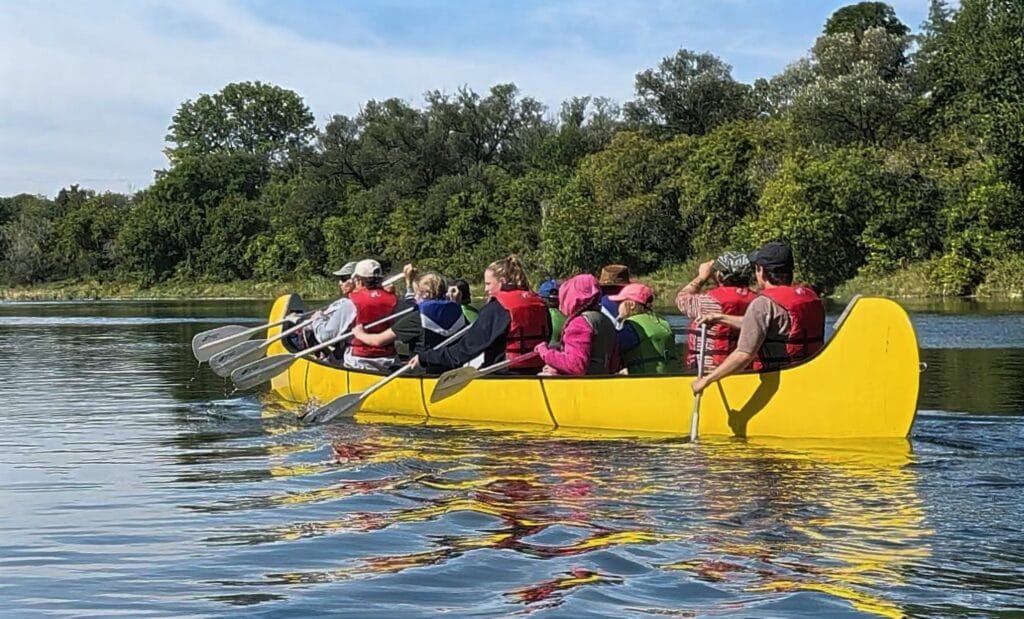
If one paddler fights the cadence, the hull drags; when all ten blades bite together, the canoe simply surges.
Getting twenty kids to row in the same direction on dry land is an uphill battle. Put them on the water, and the boat takes over the lesson. A North canoe demands immediate honesty. If one paddler fights the cadence, the hull drags; when all ten blades bite together, the canoe simply surges. It took about five minutes of clattering gunwales and tangled strokes before both crews found their rhythm.
Once the crews locked in, we turned the river into a playing field. We ran an on-the-water scavenger hunt through the side channels, sending each boat hunting for freshwater mussel shells in the shallows, tracking great blue herons lifting off gravel points, and spotting kingfishers darting along the cutbanks.
Before long, friendly banter turned into an outright sprint. We lined the two canoes up gunwale-to-gunwale in the deep pool above the islands and let them race. The valley echoed with shouted counts and frantic water as both crews leaned into their paddles, laughing and digging deep to pull ahead by half a bow length.
Floating on moving water has a way of turning abstract treaty lines into real, physical landscape.
Between the sprints, we pulled the paddles inboard, rafted the two big hulls together, and let the current carry us down the slow flats. With the Carolinian canopy hanging over the banks, we talked about why these boats exist.
While the massive 36-foot canots de maître handled the heavy swells of the Great Lakes, it was these 25-foot canots du nord that actually broke open the inland waterways. They were the backbone of early Canadian commerce, navigated through tight river bends and carried over rugged portages entirely by human grit and paddle power.
More importantly, drifting through that valley offered a direct line into the deep history of the Grand itself. We talked about the First Nations who traveled these waters for thousands of years, the heritage of the Haudenosaunee, and the Haldimand Proclamation of 1784, which set aside the land six miles on either side of the Grand River from its mouth to its source. Floating on moving water has a way of turning abstract treaty lines into real, physical landscape.
Watching the kids run those boats was a great reminder of why these traditional crafts have endured. They take a group of individuals, strip away the noise, and turn them into a single, unified crew.