
The “Canadian Tire Backcountry” Philosophy: Camping Well Without the Gear-Snob Price Tag
There is a pervasive myth in modern outdoor culture that to step off a gravel road and pitch a camp in the Ontario bush, you first need to take out a second mortgage.
Scroll through any outdoor forum or gear-enthusiast feed, and the barrier to entry feels staggering. You are told you need an ultralight tent woven from aerospace fabrics, an anodized titanium cook kit, goose-down quilts tested for Himalayan ascents, and high-fashion Scandinavian bushcraft pants. Somewhere along the line, the quiet simplicity of sleeping under the pines got buried under a mountain of four-figure price tags and gear snobbery.
The wilderness, however, does not care about brand logos.
The rain falls with the exact same weight on a high-end silicone coated fly as it does on a green hardware-store tarp. The river carries a canoe whether the paddler is wearing three-hundred-dollar Gore-Tex or an old wool work shirt. Generations of Canadian canoeists explored the Canadian Shield, ran northern rivers, and weathered October squalls without a single piece of boutique gear.
The biggest challenge with hammock camping isn’t the hang—it’s the cold air circulating beneath your back.
Take your sleep system. If you prefer sleeping off the root-tangled ground, an effective hammock setup doesn’t require a bespoke cottage-vendor order. A dependable Woods gathered-end hammock with tree straps runs under $40 for a single or $55 for a double right off the shelf at Canadian Tire. Pair it with an inexpensive $25 clip-on bug net and pitch a classic 3×4 metre poly or coated nylon tarp overhead for under $40, strung tight with ordinary utility cordage.
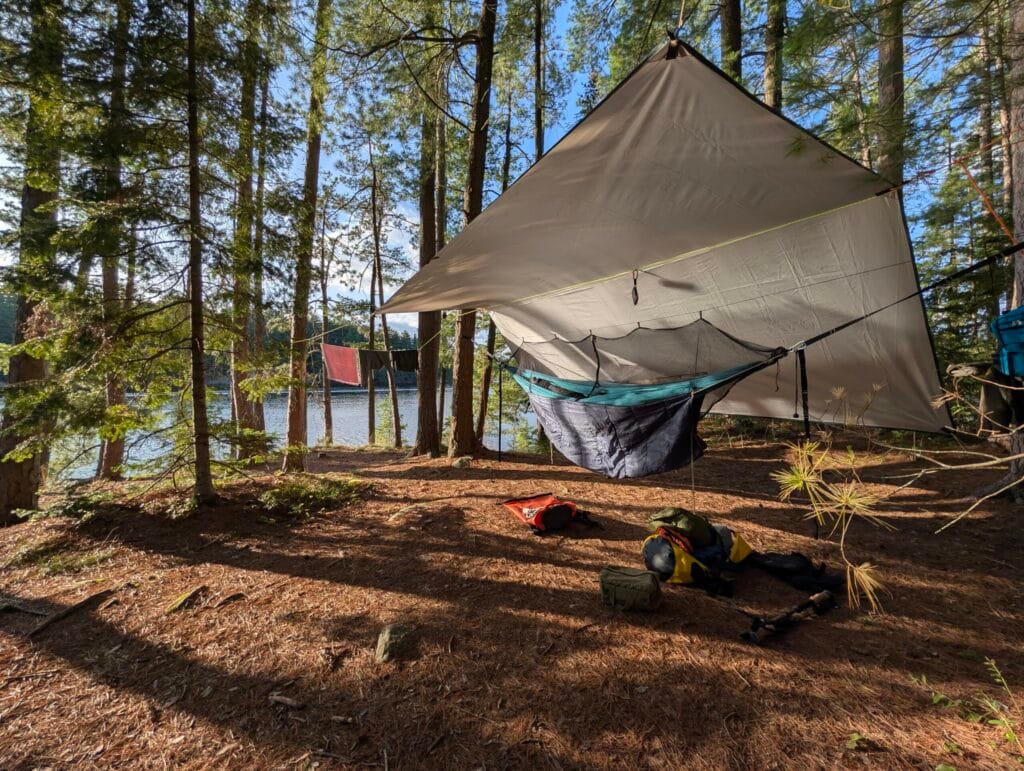
The biggest challenge with hammock camping isn’t the hang—it’s the cold air circulating beneath your back. While the gear forums will tell you a custom down underquilt is mandatory, an old synthetic sleeping bag unzipped and suspended beneath the hammock with a couple of shock cords traps warm air just as effectively.
If you prefer a tent on the ground, an honest three-person backpacking tent from an aisle you can drive to this afternoon ranges from $50 to $385. The real trick to sleeping warm on the ground isn’t your tent fabric—it’s insulation from the earth. A solid sleeping pad for $50 to $100 creates the thermal barrier you need to stop the cold ground from sapping your body heat all night. Paired with a sleeping bag suited to the season—whether a modest $30 summer barrel bag or a heavier $275 shoulder-season mummy—you have a shelter that will keep you dry, safe, and warm through practically any three-season forecast.
Walk into an IKEA, head to the kitchen department, and pick up a five-dollar Ordning stainless steel utensil holder.
Cooking in camp follows the exact same logic. A compact backpacking stove that threads directly onto an isobutane canister can be had on Amazon for under $30, or picked up at Canadian Tire for around $35. Pick up a cheap brass adapter, and you can run that same tiny burner off the green one-pound propane cylinders sitting in your garage.
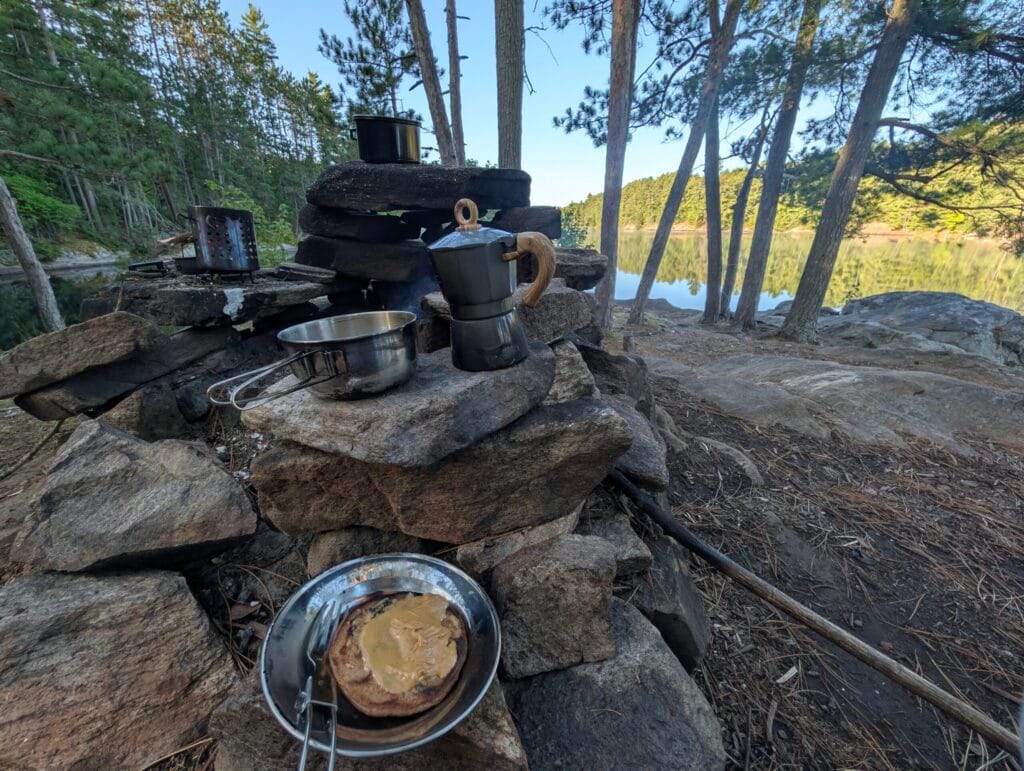
If you run out of fuel or simply prefer the scent of woodsmoke, you don’t need a hundred-dollar flat-pack titanium twig stove. Walk into an IKEA, head to the kitchen department, and pick up a five-dollar Ordning stainless steel utensil holder. Cut a small notch in the side for feeding sticks, rest your pot across the top rim, and you have one of the most efficient, indestructible forced-draft stick stoves ever devised. A modest $50 to $150 individual cookset rounds out your kitchen for years of trail use.
Keeping your life dry and hydrated is just as straightforward. Reliable inline or squeeze water filtration systems run between $20 and $50. For packing your dry goods, a set of rugged Earth Pak dry bags off Amazon—ranging from $46 to $105 depending on volume—keeps clothing and food completely sealed against splash and rain inside the hull.
And if you currently own zero camping gear and want to test the backcountry waters before buying anything at all, you don’t even need to make that initial retail run.
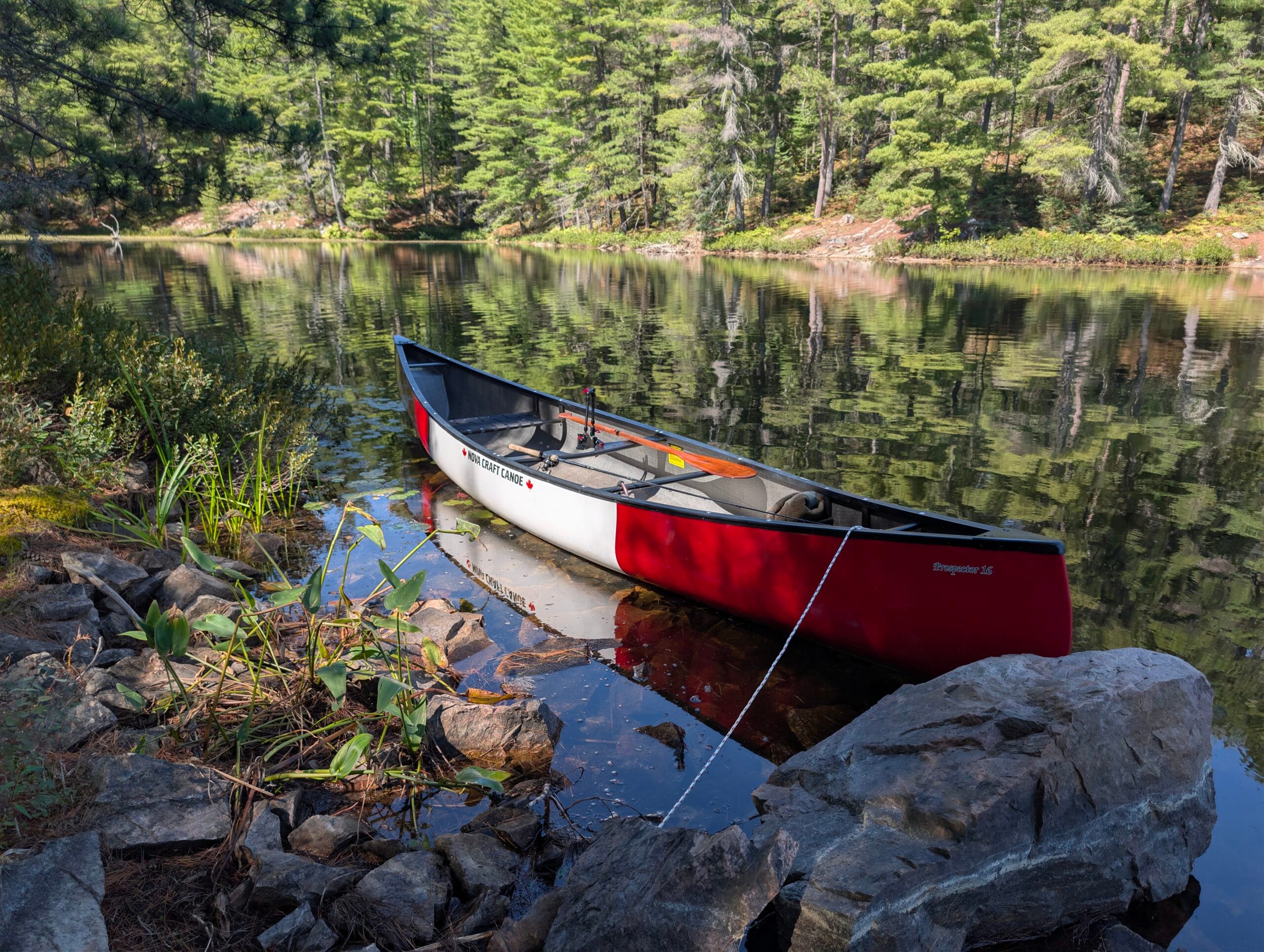
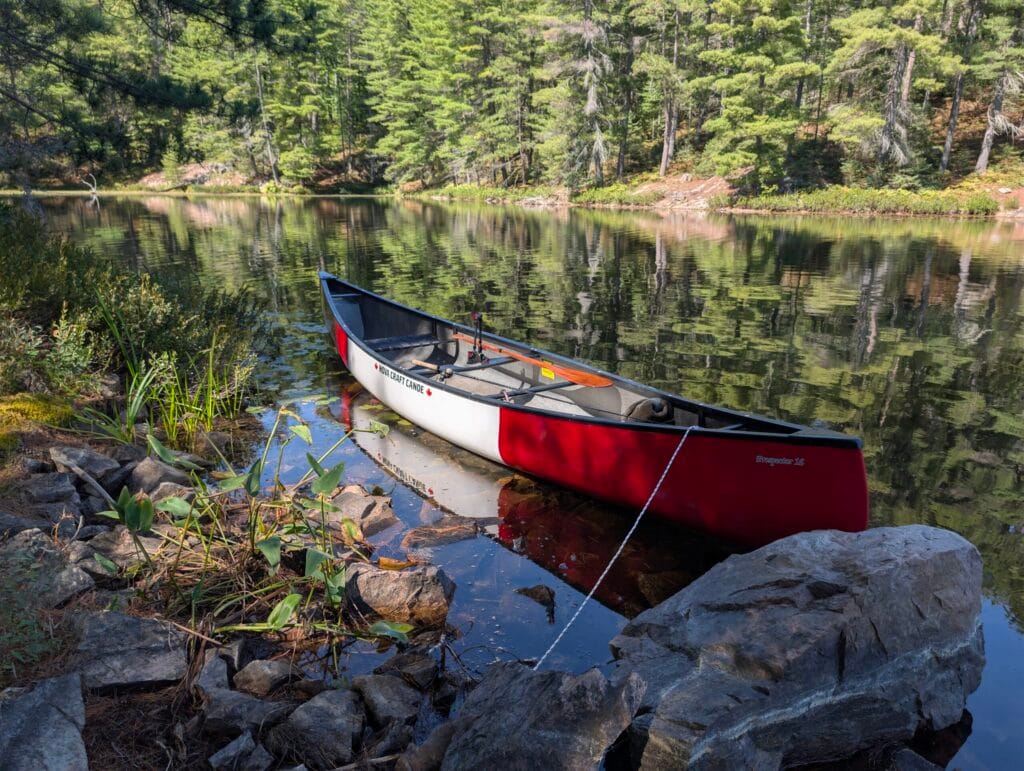
You don’t even need to own a boat to travel the lakes. Through our expedition canoe rentals, you can pick up a professional-grade Nova Craft 16′ Prospector in TuffStuff composite for $50 a day. That gives you access to thousands of kilometres of interconnected wilderness routes across Ontario without the burden of buying a boat, maintaining it, or finding a place to store a sixteen-foot hull in your garage.
And if you currently own zero camping gear and want to test the backcountry waters before buying anything at all, you don’t even need to make that initial retail run. Regional outfits like Thames Valley Outfitters specialize in complete outfitting packages, letting you rent tents, sleep systems, cook kits, and packs for your first outing. It gives you a chance to see if sleeping under the stars is for you without committing storage space or a single dollar to gear you might only use once.
When you total it up, whether renting your full kit or putting together an accessible trunk of staples, you can outfit an entire backcountry setup for a fraction of what an elitist packing list demands.
The bush is an equalizer. Knowing how to tie a taut-line hitch, pitching a tarp so the prevailing wind rolls over the ridge, knowing how to find fatwood in a damp cedar swamp, and keeping your sleep layers bone-dry matter infinitely more than the label stitched to your collar.
Don’t let gear culture convince you that the wilderness is an exclusive club reserved for gearheads with deep pockets. Grab what is accessible, test your systems on a quiet local weekend, and get out on the water.